
PHP json_decode() Function: How to Decode JSON in PHP with Examples & Online Tool
You’ve just called an API. The response comes back as a JSON string. Now what? If you’ve ever stared at a wa…
Read moreTable of Contents
JSON minification is the process of structurally preserving a JSON file or string by eliminating extraneous characters including whitespaces, line breaks, tabs, and comments. Reducing the amount of the JSON data can help to improve performance by means of faster processing by web browsers or apps and lower network traffic use.
{ "name": "John","age": 30,"city": "New York" }{ "name":"John","age":30,"city":"New York" }The readable version, which contains line breaks and spaces, is transformed into a single line without any unnecessary characters. While this is harder for humans to read, it is much more efficient for machines to process.
Minifying JSON reduces the file size, making it quicker to transmit over the network and faster for web browsers or servers to parse. This is particularly useful in optimizing the performance of web applications and APIs.
No, minification only removes unnecessary characters (like spaces and line breaks) without changing the actual data or structure. The JSON remains valid and fully functional after minification.
Yes, most JSON minifier tools, such as those from OnlineJsonFormatter or JSONFormatter, are designed to handle large JSON files efficiently. They can quickly process and reduce the size of complex datasets without losing any information.
Yes, you can "beautify" or "prettify" a minified JSON file using tools that reformat it with indentation and line breaks, restoring it to a more readable format. Many Online JSON Formatter editors offer both minify and beautify functions.
You’ve just called an API. The response comes back as a JSON string. Now what? If you’ve ever stared at a wa…
Read more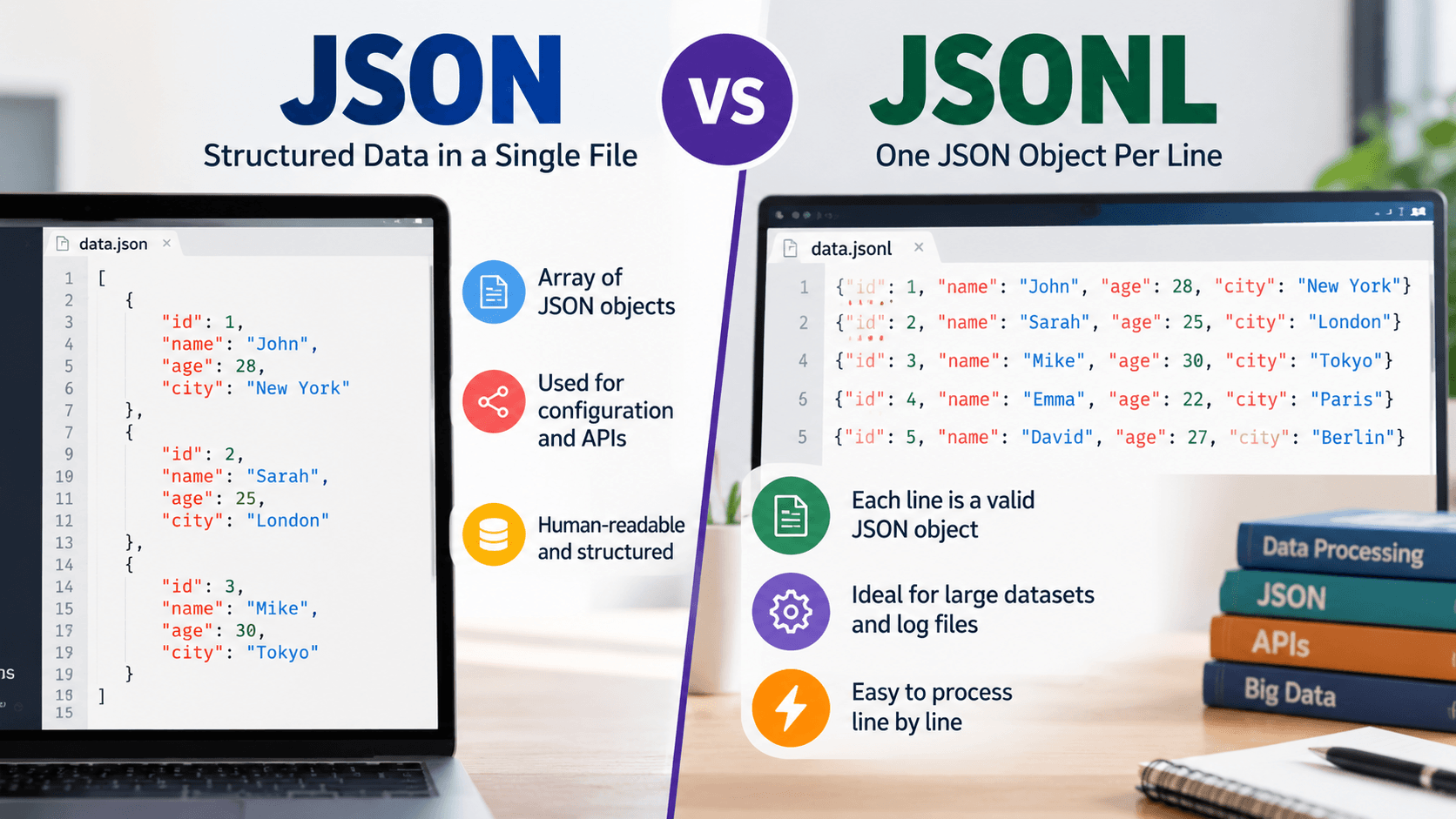
JSONL, or JSON Lines,s is a typical JSON format in which each line is a valid JSON value. The JSONL file normally has a …
Read more
Any Large Language Model (LLM) writes text content one token at a time, and then writes the next token. text one token a…
Read more