
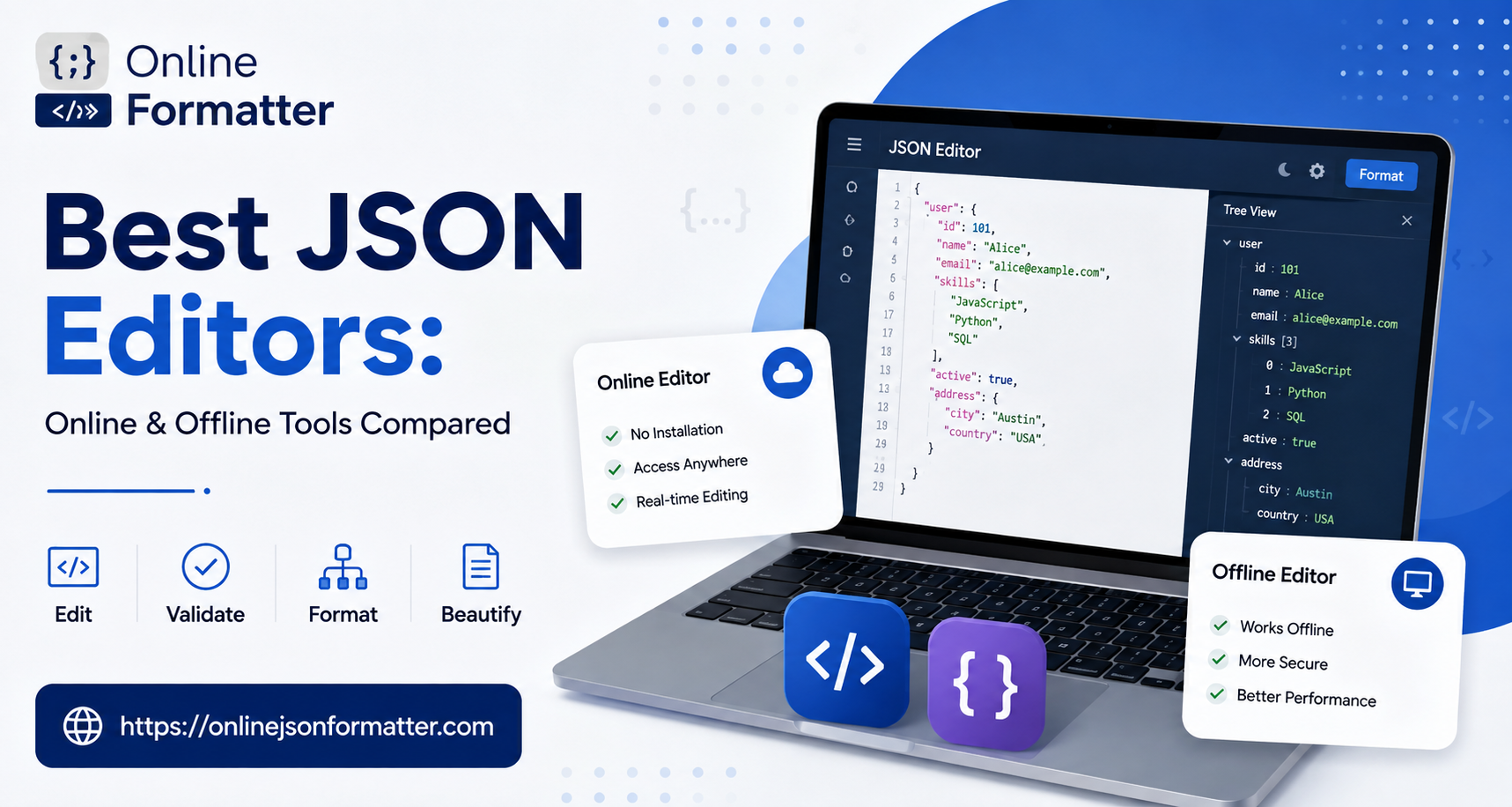

You open a .json file in Notepad. One missing comma later, your entire app crashes.
Sound familiar?
JSON is everywhere API responses, config files, database exports, CI/CD pipelines. But editing JSON without the right tool is painful. A misplaced bracket, a trailing comma, an unescaped quote and suddenly nothing works. Before making changes, it’s often helpful to use a JSON Viewer to inspect the structure of your data and a JSON Formatter to make complex JSON easier to read and debug.
The good news? There are excellent tools that make JSON editing faster, safer, and honestly kind of enjoyable. This guide covers everything from quick online editors to full-featured desktop apps, so you can pick what works for your setup.
What Is a JSON File (And Why Is It So Sensitive)?
JSON stands for JavaScript Object Notation. It’s a lightweight format for storing and exchanging data.
Here’s what a basic JSON file looks like:
{
  "name": "Alice",
  "age": 30,
  "skills": ["JavaScript", "Python", "SQL"],
  "address": {
    "city": "Austin",
    "country": "USA"
  }
}
Clean, readable, and structured.
But JSON has strict rules:
- All strings must use double quotes (not single)
- No trailing commas after the last key-value pair
- Keys must also be strings in double quotes
- No comments allowed
A single violation breaks the whole file. That’s why a proper JSON editor one that validates as you type is worth its weight in gold.
JSON Editor vs JSON Viewer: What’s the Difference?
Before diving in, let’s clear this up it’s a question that trips up a lot of people.
| Feature | JSON Viewer | JSON Editor |
|---|---|---|
| Read/browse JSON | ✅ | ✅ |
| Edit values | ❌ | ✅ |
| Validate syntax | Sometimes | ✅ |
| Format/prettify | Sometimes | ✅ |
| Tree view navigation | ✅ | ✅ |
A JSON viewer is great for exploring data. A JSON editor lets you actually modify it. Most good tools do both but it’s worth knowing what you’re getting before you commit to one.
Best Online JSON Editor Tools (Free)
If you’re working on a quick edit or need to share something with a teammate, online tools are the fastest option. No install, no setup.
1. JSONEditorOnline.org
One of the most popular choices for developers. It has a split-pane view raw JSON on the left, tree view on the right. You can edit in either panel and they sync in real-time.
Best for: Quick edits + navigating deeply nested JSON
Standout feature: Import/export from URL, file, or clipboard
2. JSON Formatter & Validator (jsonformatter.curiousconcept.com)
This is your go-to when someone throws a single-line minified blob at you. Paste it in, click Format, and you’ve got a clean readable structure instantly. It also validates and highlights exactly where errors are.
Before (Minified)
{"user":{"id":1,"name":"Bob","active":true}}After Formatting
{
  "user": {
    "id": 1,
    "name": "Bob",
    "active": true
  }
}
Best for: Formatting + basic validation
3. JSONLint (jsonlint.com)
The classic. Paste your JSON, hit Validate, and it either confirms it’s valid or tells you exactly which line broke.
No frills, no distractions just accuracy.
Best for: Validating JSON fast without editing
4. JSON Crack (jsoncrack.com)
Here’s where it gets cool. JSON Crack visualizes your JSON as an interactive graph. Perfect when you’re dealing with nested structures that look like a maze in text form.
Best for: Exploring complex or deeply nested JSON visually
Best Offline JSON Editor Tools
Sometimes you need to work without an internet connection or you’re dealing with sensitive data you’d rather not paste into a browser. Desktop tools have your back.
1. VS Code (Free – Windows, Mac, Linux)
VS Code is probably already your editor of choice. And for JSON, it’s genuinely excellent.
It gives you:
- Syntax highlighting and real-time validation
- Auto-formatting with Shift + Alt + F
- IntelliSense for schema-backed JSON (like settings.json, package.json)
- JSON folding to collapse nested sections
How to Format a JSON File in VS Code
- Open the
.jsonfile - Press
Ctrl + Shift + P(orCmd + Shift + Pon Mac) - Type Format Document
- Hit Enter
Done. VS Code uses its built-in JSON formatter to clean up your file instantly.
Best for: Everyday dev work, config files, large files
2. Sublime Text (Free to Try – Windows, Mac, Linux)
Sublime is fast. Extremely fast.
For large JSON files, it opens in a fraction of the time VS Code takes.
Install the Pretty JSON plugin and you’ve got formatting + validation built in.
Path: Right-click → Pretty JSON → Format or Validate
Best for: Large JSON files where performance matters
3. Notepad++ with JSON Viewer Plugin (Free – Windows)
If you’re on Windows and love lightweight tools, Notepad++ with the JSON Viewer plugin is a solid combo.
It adds a panel where you can browse JSON as a tree while editing the raw text.
Best for: Windows users who want a lightweight editor
4. JSONBuddy (Paid – Windows)
JSONBuddy is a dedicated JSON editor for Windows with schema support, auto-complete, and a full-on table view for editing arrays of objects.
It’s a niche product but excellent if you work with complex JSON schemas daily.
Best for: Teams dealing with JSON Schema validation and large structured data
How to Edit a JSON File Without Coding
Not every person editing a JSON file is a developer.
If you’re a non-technical user maybe editing a config file for a plugin or app here’s the simplest approach:
Step 1: Open an Online Editor
Go to JSONEditorOnline.org and paste your JSON.
Step 2: Switch to Tree View
Click the tree icon. Now your JSON looks like folders and files no brackets, no commas.
Step 3: Edit Values Directly
Click any value to change it.
Add keys, delete nodes, rename fields. The editor handles all the syntax for you.
Step 4: Copy the Output
Switch back to Text view, copy the result, and paste it back where you need it.
That’s it. No coding required.
Step-by-Step: Edit a JSON File in VS Code
Let’s go through a realistic example.
Say you have a config file for a Node.js app:
{
  "app": {
    "name": "MyApp",
    "version": "1.0.0",
    "port": 3000,
    "debug": false
  },
  "database": {
    "host": "localhost",
    "port": 5432,
    "name": "myapp_db"
  }
}
You need to change the port from 3000 to 8080 and enable debug mode.
Step 1 Open the File in VS Code
Open the file in VS Code.
Step 2: Change the Port Value
Find:
"port": 3000Change it to:
"port": 8080Step 3: Enable Debug Mode
Change:
"debug": falseto:
"debug": trueStep 4: Save the File
Press Ctrl + S to save.
Step 5: Format the JSON
Press Shift + Alt + F to auto-format and make sure everything looks right.
Result
{
  "app": {
    "name": "MyApp",
    "version": "1.0.0",
    "port": 8080,
    "debug": true
  },
  "database": {
    "host": "localhost",
    "port": 5432,
    "name": "myapp_db"
  }
}
VS Code will underline any errors in red as you type. No need to manually validate.
Common JSON Editing Mistakes (And How to Fix Them)
Here’s where most developers slip up especially when editing manually.
Mistake 1: Trailing Comma
❌ Invalid
{
  "name": "Alice",
  "age": 30,
}
✅ Valid
{
  "name": "Alice",
  "age": 30
}
JSON doesn’t allow a comma after the last item. Most editors catch this plain text editors don’t.
Mistake 2: Single Quotes Instead of Double Quotes
❌ Invalid
{
  'name': 'Alice'
}
✅ Valid
{
  "name": "Alice"
}
JavaScript is fine with single quotes. JSON is not.
This is one of the most common causes of parse errors when copying values from JS files.
Mistake 3: Comments in JSON
❌ Invalid
{
  // This is the user's name
  "name": "Alice"
}
Pure JSON doesn’t support comments.
If you need annotations, consider JSONC (used in VS Code config files) or switch to YAML.
Mistake 4: Unescaped Special Characters
❌ Invalid
{
  "message": "She said "hello""
}
✅ Valid
{
  "message": "She said \"hello\""
}
Double quotes inside a string value must be escaped with a backslash.
JSON Editor Tools Comparison Table
| Tool | Type | Platform | Free | Best Use Case |
|---|---|---|---|---|
| JSONEditorOnline | Online | Browser | ✅ | Quick edits + tree navigation |
| JSON Formatter | Online | Browser | ✅ | Formatting + validation |
| JSONLint | Online | Browser | ✅ | Pure validation |
| JSON Crack | Online | Browser | ✅ | Visual exploration |
| VS Code | Offline | Win/Mac/Linux | ✅ | Day-to-day dev work |
| Sublime Text | Offline | Win/Mac/Linux | Mostly | Large file performance |
| Notepad++ | Offline | Windows | ✅ | Lightweight Windows editing |
| JSONBuddy | Offline | Windows | ❌ | Schema-driven enterprise use |
When to Use Online vs Offline JSON Editors
Use an Online JSON Editor When:
- You need a quick format or validation check
- You’re sharing or reviewing data with a teammate
- You don’t have a code editor installed
- You want a visual tree view without setting anything up
Use an Offline JSON Editor When:
- The file contains sensitive data (API keys, credentials, PII)
- You’re working without an internet connection
- The file is very large (100KB+)
- You’re doing repeated edits as part of a dev workflow
Best Practices for Editing JSON Files
A few habits that’ll save you headaches:
- Always validate after editing. Even in VS Code, paste your JSON into JSONLint before deploying. Takes 5 seconds.
- Use schema validation when possible. If your JSON follows a fixed structure, define a JSON Schema and hook it up to your editor.
- Keep a backup before large edits. Especially for config files.
- Format before committing to Git. Consistent formatting avoids noisy diffs.
- Avoid manual editing for large arrays. If you’re editing an array of 200 objects, write a script.
Real-World Use Cases for JSON Editing
1. Editing App Configuration Files
config.json, settings.json, .eslintrc most modern dev tools use JSON for configuration.
Editing these is a daily task.
2. Modifying API Responses During Testing
When testing with mocked data, you’ll often tweak JSON response fixtures to cover edge cases.
3. Updating Translation Files
Localization files such as en.json and fr.json are JSON-based.
Translators and developers regularly edit these files.
4. Debugging Webhook Payloads
Incoming webhook data often arrives as JSON.
Formatting and inspecting it quickly is essential for debugging.
5. Managing package.json in Node.js Projects
Every Node.js developer edits package.json constantly adding dependencies, scripts, and metadata.
Conclusion
Editing JSON files doesn’t have to be a guessing game.
Whether you’re using a fast online tool for a quick fix or VS Code for daily dev work, the right editor makes all the difference.
Quick Recap
- Online, no install needed? → Try our JSON Editor or JSON Formatter tools.
- Need to validate fast? → JSONLint
- Visual exploration of complex JSON? → JSON Crack
- Everyday dev editing? → VS Code
- Lightweight + Windows? → Notepad++ with JSON Viewer
The golden rule: never edit JSON in a plain text editor without validation.
One misplaced comma will cost you more time than the edit saved you.
Pick your tool, set it up once, and editing JSON becomes second nature.


